Why did the massive redevelopment project stall while the "neighboring town" continued to move forward? — A story about "proactiveness" that works for business management.
Why did the massive redevelopment project stall while the "neighboring town" continued to move forward? — A story about "proactiveness" that works for business management.
How will the landscape in front of Nagoya Station change in the future? Business owners and executives based in Nagoya have undoubtedly been concerned about this. It was at the end of 2025 that news broke that the large-scale redevelopment of the area around Meitetsu Nagoya Station had been "effectively scrapped." This major renovation of the "gateway to the Chubu region," which was initially aimed at completion of the first phase in fiscal year 2033 and is said to have a total project cost of 540 billion yen, has been left in limbo, including the start of demolition work, due to soaring construction costs and labor shortages.
I didn't read this news as simply a story about real estate or urban planning. Rather, I see it as a microcosm of business management itself. This is because, if you look at the "Meieki Minami" area, about a 10-minute walk south of Nagoya Station, even though it's not driven by a massive flagship project, developments such as high-rise condominiums, hotels, flagship dealerships for imported cars, and road improvements are steadily accumulating, changing the face of the town. Within walking distance of Nagoya Station, one area is stagnant while the other continues to move. I believe there are hints about the perspective that business managers should have in this contrast.
Why are "grand plans" more likely to stall?
Rising construction costs and labor shortages are being called the "2026 problem for the construction industry," and are causing simultaneous postponements and freezes of redevelopment projects across the country. The postponement of numerous redevelopment projects in Shinjuku, Shibuya, and Nakano, which were said to be "once-in-a-century" projects, is a symbolic manifestation of this problem, not just the massive project in front of Meitetsu Nagoya Station. Surveys targeting urban redevelopment projects have shown that nearly 70% of projects with subsidies have seen increases from their initial budgets, and some have pointed out that in about 30% of cases, in addition to subsidies from the national and local governments, the developers are also purchasing part of the floor space, essentially resulting in a "double injection of public funds."
Another common issue that emerges when examining failed redevelopment projects is the ambiguity surrounding "who is primarily bearing the risk." In one case of a failed redevelopment project in a regional city, landowners and union officials left the project entirely to the developer, losing their sense of ownership, which later came back to haunt them in the form of compensation for losses. The grander the plan, the more stakeholders there are, and the subject of decision-making becomes diluted from "someone" to "everyone." I believe this applies to corporate management as well, regardless of scale. I don't deny the value of having a grand vision, but if the entity responsible for executing it isn't clear, the plan can easily come to a halt.
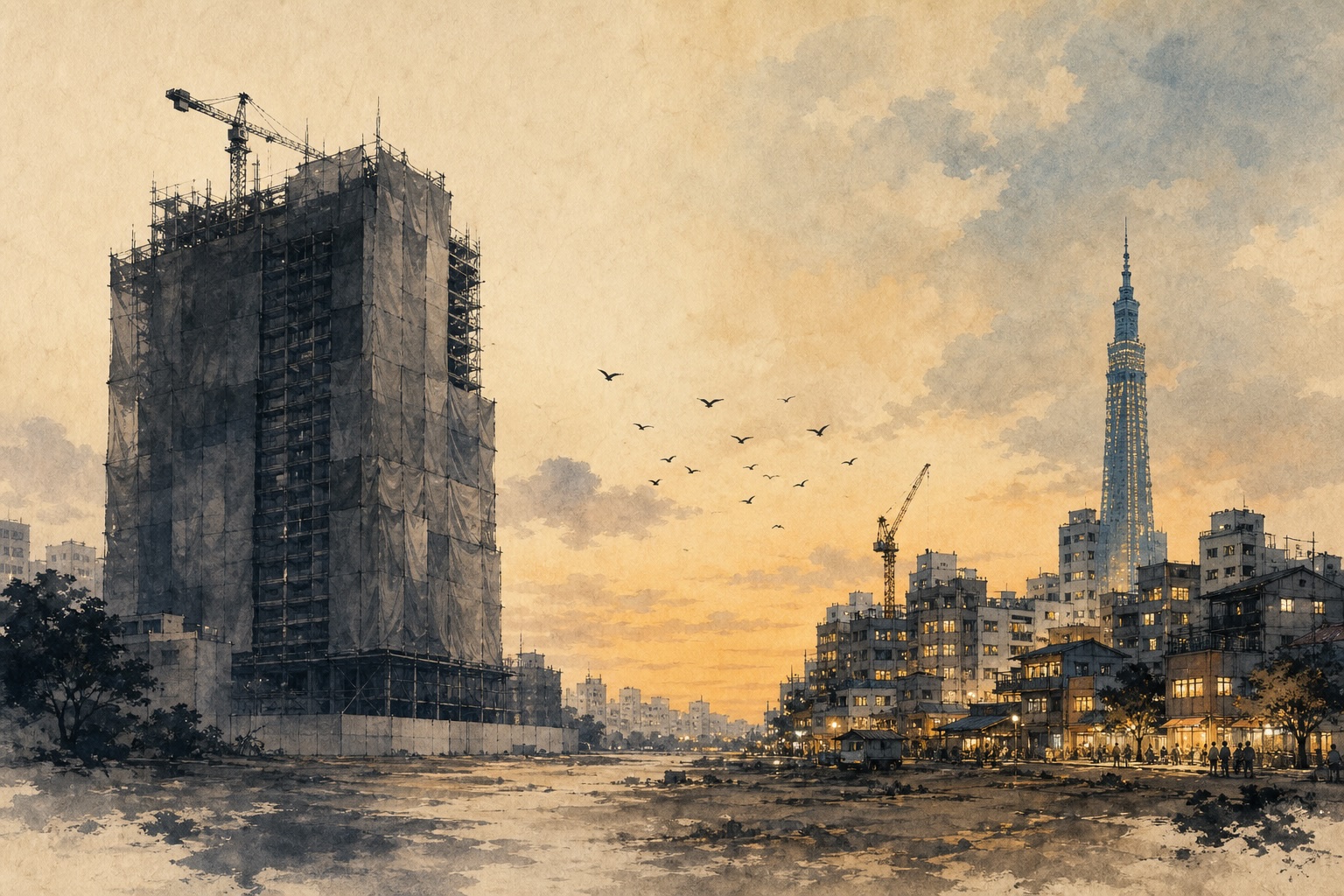
Walking around the site, you can visually see that "time has stopped." Although the construction itself has been postponed, the commercial facilities, including Meitetsu Department Store, have closed as planned, with a few exceptions, and the signs remain covered with blue sheets. The sight of the buildings, neither demolished nor construction started, standing there with their undecided destinations hidden, seemed to be a kind of symbol of the lack of scale and execution in the plan.
However, the story doesn't end there. In July 2026, just recently, a surprising piece of news broke that seemed to forcibly restart this "stopped time." Meitetsu announced that it would be urgently attracting and opening a Yodobashi Camera store in this vacant building in the summer of 2026, the first of its kind in the Nagoya Station area.
Instead of passively waiting for the massive 540 billion yen redevelopment project to begin in earnest, Meitetsu itself has steered in the direction of "taking the best possible action today with the assets we have." This decision to forcefully break through the frozen landscape in front of the station with the power of the private sector is surely a demonstration of proactive thinking, or "thinking while running."
Why did the areas that didn't wait for the "order" move forward?
On the other hand, the area south of Nagoya Station was not driven by a major government-led project. After the war, it was a town that mainly consisted of logistics-related facilities, essentially a "transit point." However, since the 2000s, the area has seen an increase in the location of offices, schools, and residences, and since the Reiwa era began, the following changes have accumulated.
In 2023, "NAGOYA THE TOWER," a 42-story tower condominium with a top floor priced at 400 million yen, was completed.
Several hotel chains, including Toyoko Inn and Daiwa Roynet Hotel, have opened in quick succession.
In March 2026, one of the largest authorized Porsche dealerships in Japan will open.
The widening and improvement of city roads has progressed, improving connectivity with the adjacent "Sasashima Live 24" area.
None of these actions were initiated by a single, unspoken order. They are the result of each company making decisions and taking action based on its own market judgment. While Nagoya City has set forth a guideline called the "Meieki South Urban Development Policy," I believe this merely creates a "soil" that facilitates the accumulation of individual private investments, and that it is actually the countless individual decisions that drive the city forward.
The larger the plan, the harder it is to notice bottlenecks.
In organizational theory, there's a well-known concept called "The Goal." This theory states that overall productivity is determined by the most restrictive process, the so-called bottleneck. In the case of large-scale redevelopment, if even one part—such as material procurement, consensus building, or the subsidy application process—gets stuck, the entire plan will come to a halt. Naturally, the more stakeholders involved in a project, the harder it becomes to even see where the bottleneck lies.
What I focus on in management is clarifying "who can do what today" before scaling up a plan. I believe that setting a grand vision and clearly defining the entities that will drive it should go hand in hand. However, in many organizations, the vision takes precedence, and time passes without a clear subject for execution. This is surprisingly similar to the situation facing the redevelopment of the area in front of Meitetsu Nagoya Station.
For over 20 years since our founding, I've had the opportunity to speak with executives and key figures from various companies, and I've encountered similar scenarios many times. While the "big picture"—such as a medium-term management plan or brand slogan—is beautifully drawn, the execution phase is stalled, with blanks remaining for "who," "by when," and "what to do." I believe that success or failure depends far more on whether all stakeholders share, with the same level of clarity, who the key players are in driving that picture forward today, rather than the grandeur of the picture itself.
What small and medium-sized enterprises can start doing today
The lesson we can learn from the changes in the Meieki South area is that you don't need to wait for a "perfect one-shot" solution. A single hotel, an apartment building, or a single shop may not have the same impact as a "station front redevelopment" project on their own. However, as a result of each company making decisions based on their own judgment and timing, over a period of 5 or 10 years, they have undeniably changed the landscape of the city.
I believe the same can be said for the management of medium-sized and small businesses. It is important to have a grand medium-term management plan and an ambitious brand strategy. However, the first step in putting them into action is often small and unassuming. The number of people and teams within a company who have the attitude of "just take action" and "try small and think as they go" will ultimately make a big difference in a few years. This is the reason why, in recruitment and training, we emphasize the ability to formulate hypotheses in places where there are no right answers, to work diligently and get it right, and to keep trying again and again.
Summary: Cities and organizations change when people take action.
I am closely watching the redevelopment of the area in front of Meitetsu Nagoya Station, wondering when and in what form it will begin. As a business owner based in Nagoya, I am also closely monitoring its progress. However, the future of a city is not determined by a single massive project. What I realized again while following the changes in the area south of Nagoya Station is that, even before discussing the merits of a large-scale plan, the total amount of initiative—"who is moving what today"—is what shapes the future of the city and the organization.
If, upon reflecting on your own company, you find yourself thinking, "We have a grand vision, but I can't immediately answer who the driving force behind it is today," then that's not uncommon at all. In fact, it's a form of stagnation that many companies go through at some point. I believe the important thing is how to find that driving force, how to articulate it, and how to instill it throughout the organization. I would be delighted to continue this discussion with business leaders who are grappling with such questions, perhaps sometime in Nagoya.
WRITTEN BY
Ichikawa Atsushi
Representative Director and Chairman
After starting his own business at the age of 26, he has over 20 years of management experience in the design and branding fields. In 2016, he moved with his family to the Philippines and established a local IT outsourcing company, leading its global expansion. Currently, as a "GLOBAL BRANDING AGENCY," he supports the growth of companies while also actively working on organizational reforms within his own company. Based on the real-world struggles and firsthand information he has faced in organizational development and overseas management, he shares practical branding and organizational theories that are thoroughly aligned with the perspective of business leaders.