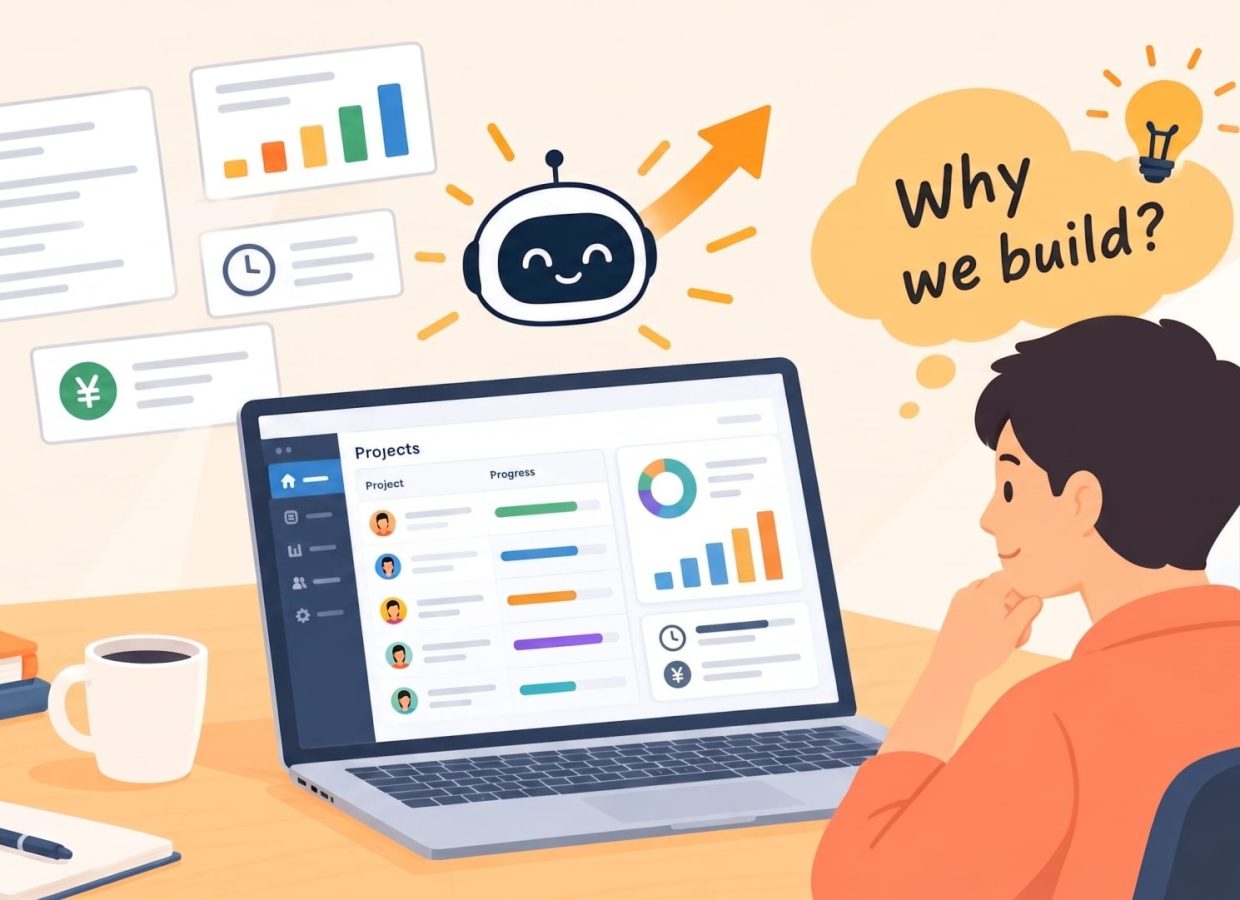
Transforming its Philippine subsidiary from an "assistant" to a "lab" – a management decision to turn overseas bases into centers for innovation.
When you hear the word "Philippines," what comes to mind first for your company? Call centers, BPO, or perhaps an offshore development location with low labor costs. For many business owners, the Philippines is still seen as a base for achieving "cheap and fast" solutions.
Actually, I feel this perspective is a bit of a waste. I myself run a global branding agency called Lionheart Co., Ltd. in Nagoya, and have had a subsidiary in the Philippines for over 10 years. Initially, it was positioned as an "assistant" to support the production work of the Japanese subsidiary. However, recently I have decided to fundamentally reconsider that structure.
This time, I'll talk about how we redefined our Philippine subsidiary from an "assistant" to an "experimental lab," and the new ways we've seen how to leverage overseas bases. To put it simply, I believe that transforming overseas bases from "subcontractors that cheaply and quickly carry out instructions from headquarters" to "experimental hubs that try things out before headquarters and bring the results back" will be a source of competitiveness for small and medium-sized enterprises going forward.
Why the Philippines is called "world-class" - Strengths seen in numbers
The Philippines' strengths are clearly reflected in the numbers, not just in our perceptions. The number of English speakers in the Philippines is the third largest in the world, after the United States and India, with approximately 90% of the population able to speak English. The Philippines is the second largest country in the world in terms of the scale of its BPO (Business Process Outsourcing) industry. Furthermore, while neighboring countries are expected to see their "demographic dividend," with a continuously growing working-age population, peak between the late 2020s and 2040s, the Philippines alone is projected to continue this until 2062.
Geographical advantages cannot be overlooked. It's only about a 4.5-hour direct flight from Narita, with a time difference of just one hour. More than 1,500 Japanese companies have already established bases there, and collaborations are increasing not only in manufacturing and BPO, but also in software development and fintech in recent years. In short, the Philippines is not just a source of "cheap labor," but is quietly increasing its presence as "another business resource" that is young, English-speaking, and can work without a time difference.
This change is not irrelevant to our creative branding industry. Previously, the Philippines' strengths lay primarily in voice-based call center support and simple production work outsourcing. However, now, young designers and engineers in the Philippines are absorbing new tools and AI technologies at a speed comparable to, or even exceeding, their Japanese counterparts. I believe that managers who view their bases solely in terms of "cheap labor" are the ones who will be slow to notice this shift.
Are you only looking at "cheap and fast"? – A common misconception among many Japanese companies.
Nevertheless, many Japanese companies, including ours, tend to view overseas bases as "cost centers." We entrust tasks to them because labor costs are cheaper, or we have them take over tasks because our Japanese employees are busy. In itself, this is not a wrong business decision. However, if we continue with this mindset, our overseas bases will never move beyond being "subcontractors for headquarters."
In the world of business management, there's a concept called "reverse innovation." It refers to the phenomenon where technologies and services developed for emerging markets become popular in developed markets. While this term is often used in the context of product development, I believe the same idea can be applied to organizational development. I wondered if we could transform our overseas offices from places where we simply execute instructions from headquarters to places where we can try things out before headquarters does. That's what led to this decision.
Our Management Decision: Transforming Our Philippine Subsidiary from an "Assistant" to a "Lab"
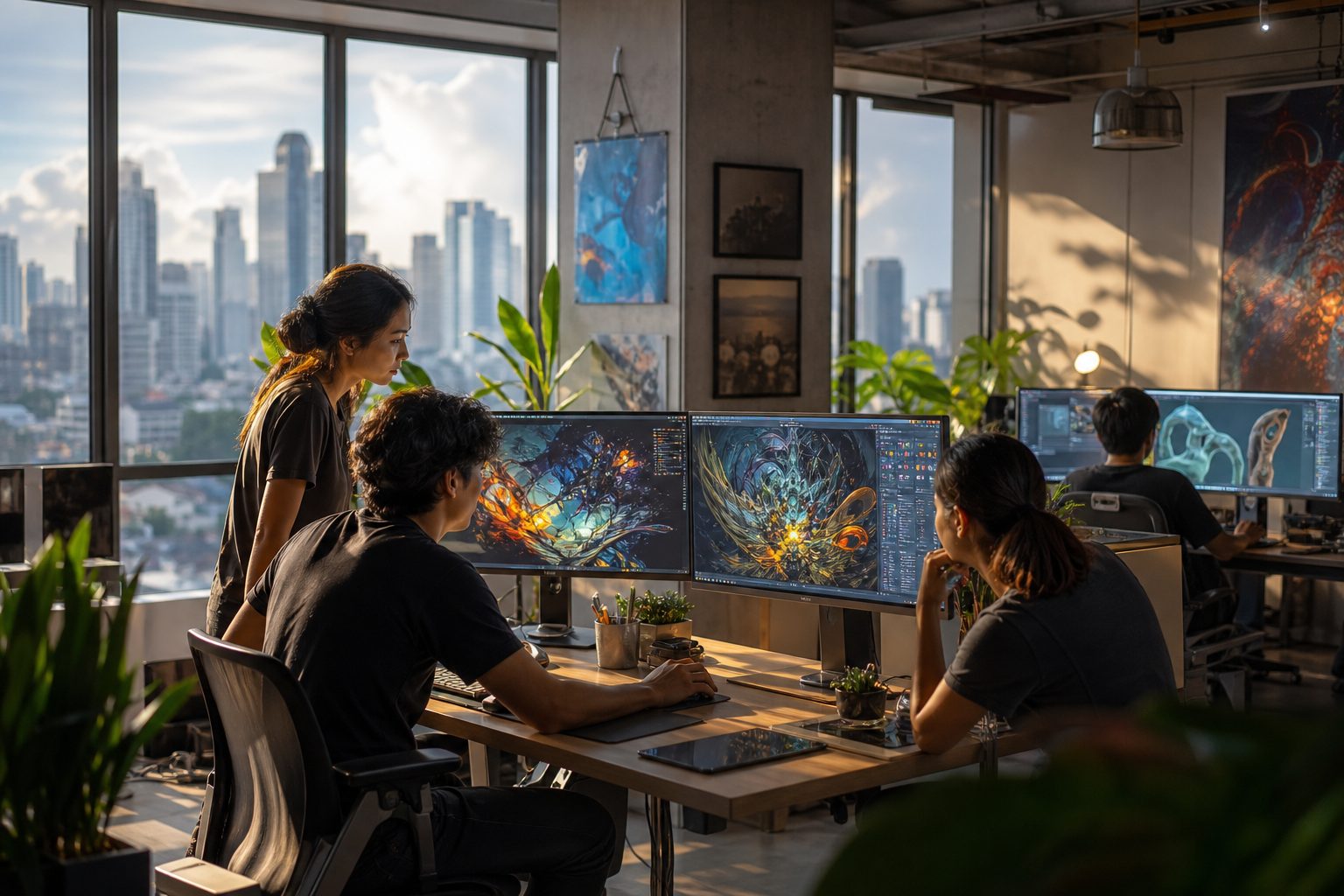
What we are currently working on is redefining our Philippine subsidiary as a "Lab" for experimenting with rich expressions in the realm of digital art. We believe that the world of websites will become polarized into two areas: the "conventional realm" that AI can handle, and the "unconventional realm" where human sensibility is involved. A prime example of the latter is digital art-like expressions that make full use of animation and 3DCG. The delicate timing and direction that cannot be properly reproduced with prompt instructions alone can only be achieved through trial and error by humans working with their hands.
To be honest, we don't often get requests for this kind of expression from our current clients. However, our clients' challenges are diverse. If we don't have the necessary tools when the need arises, we can't even make a proposal. It's too late to act only when demand comes. Therefore, we have created a system in which designers and engineers in the Philippines collaborate to proactively conduct implementation experiments in this area.
I believe that the conditions for an overseas base to function as a "Lab" ultimately boil down to the following three:
Take action and increase your "hand" before demand arises.
Instead of a one-way flow from headquarters to the field, create a system that allows results to flow back from the field to headquarters.
Positioning the opportunity for challenge itself as a growth opportunity and retention strategy for local members.
The Philippines is ahead, and Japan is chasing – the tension created by this reversal of fortunes.
What we intentionally changed with this initiative is the direction of information flow. Until now, the structure was that work was "handed over" from Japan to the Philippines. We've reversed that, creating a structure where we first conduct experiments in the Philippines and then "import" the results achieved there back to Japan.
Previously, we conducted an experiment in AI-powered coding in the Philippines and shared the results online with the Japanese team. This was an area that our Japanese subsidiary hadn't yet tackled, so I think it was quite stimulating for our Japanese staff. To be honest, I also wanted to instill a sense of urgency in our Japanese staff. It's okay for our overseas offices to overtake headquarters at some point. I believe that this kind of tension will drive the entire organization forward.
"I want to challenge myself with new technologies"—What our local team members told us about their reasons for changing jobs
This shift in policy was driven by feedback from our local team members. Looking back at the reasons why our Filipino team members left the company, many said they wanted to "challenge themselves with new technologies." Highly skilled individuals tend to get bored with repetitive tasks and the same technologies. Because they are highly motivated, they will leave an environment where they don't feel they are growing.
This aligns with the overall trend in the talent market. Filipino talent tends to prioritize short-term growth opportunities—one year, two to three years—over long-term career plans of five or ten years. Instead of a seniority-based system, opportunities for challenges are key to employee retention. Therefore, providing a "Lab"—a platform for challenges—is not only a technical preparation for the company but also the most effective talent retention strategy. Company preparation and member growth progress simultaneously. This is the effect we most hope for from this experiment.
I believe this perspective will be particularly useful for business owners in Japan who are struggling with recruitment and retention. It's not just about competing on salary and benefits; the environment itself—the opportunity to try things you can't do anywhere else—has the power to attract and retain people. The same can be said for Japanese employees as well.
Summary – Transforming overseas bases from cost centers into "bases for challenges"
The reason the Philippines is considered "world-class" isn't just because of its low prices and speed. I believe it's because it has young, English-speaking people who, above all, possess a strong desire to take on challenges. How to harness that energy depends on the management decisions of the receiving company.
Whether overseas bases remain merely "places to run things cheaply and quickly" or are transformed into "places where we can test things before headquarters," I believe the deciding factor lies not in the size or budget of the base, but in the role that management assigns to it.
Our experiment in the Philippines has only just begun. We will see both successes and setbacks. However, we believe that this trial-and-error process itself will be invaluable in expanding the possibilities of branding and digital expression. If your company is struggling with how to utilize its overseas bases or talent, why not take a look at the "desire to take on challenges" that may still be dormant within those locations? I would love to have a frank exchange of information with other business leaders who are facing similar challenges.
WRITTEN BY
Ichikawa Atsushi
Representative Director and Chairman
After starting his own business at the age of 26, he has over 20 years of management experience in the design and branding fields. In 2016, he moved with his family to the Philippines and established a local IT outsourcing company, leading its global expansion. Currently, as a "GLOBAL BRANDING AGENCY," he supports the growth of companies while also actively working on organizational reforms within his own company. Based on the real-world struggles and firsthand information he has faced in organizational development and overseas management, he shares practical branding and organizational theories that are thoroughly aligned with the perspective of business leaders.