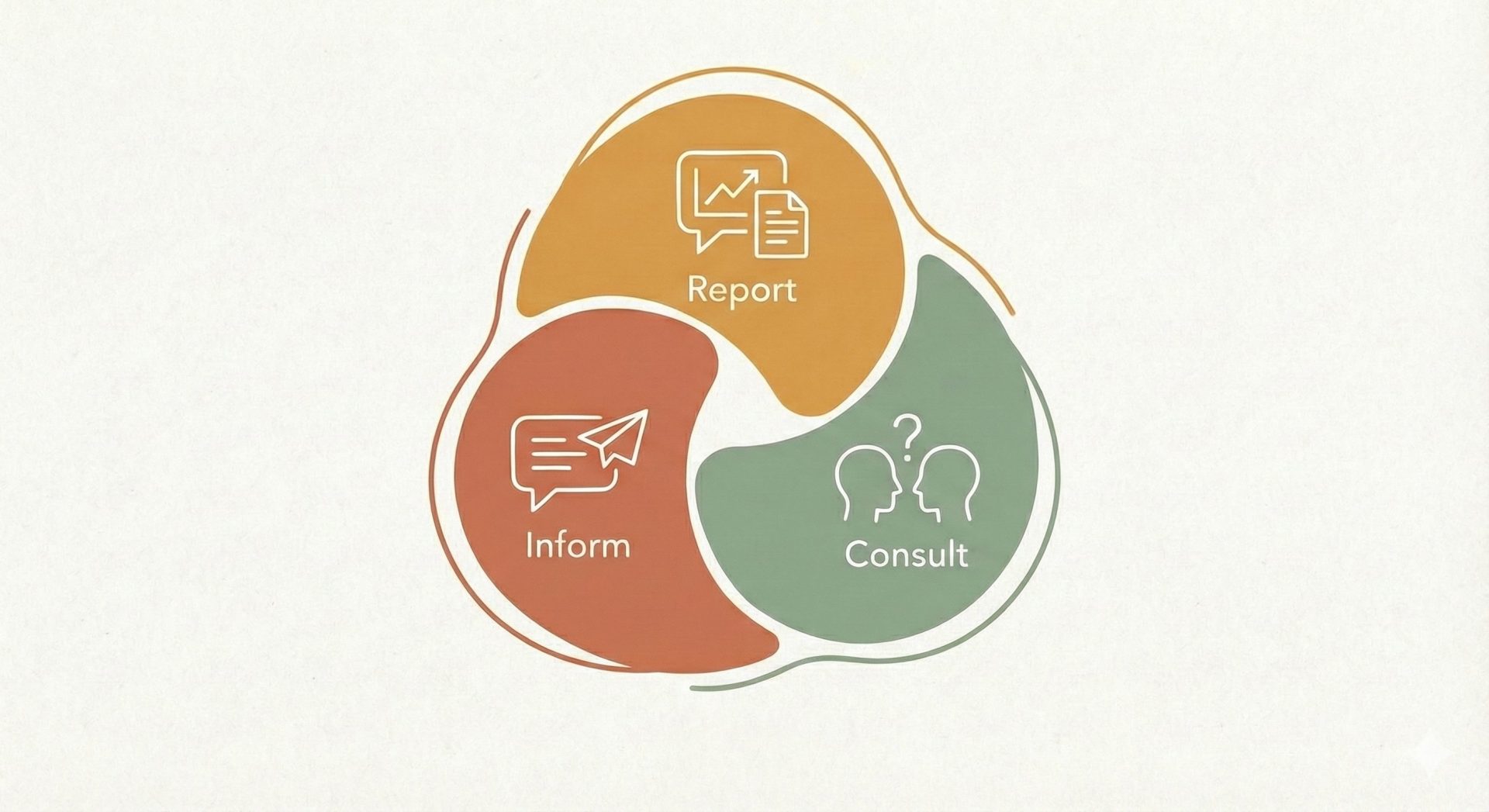
Have you ever been a bit puzzled trying to translate the Japanese word "報連相" into English because you couldn't find a perfectly fitting expression?
Report, Inform, Consult
The meaning is close, but it's somehow different.
That is surely, because reporting, contacting, and consulting is not merely a business act,Because it is a “custom” that embodies Japanese business culture itselfI think so.
Lately, I've noticed more instances where internal reporting, communication, and consultation have become less frequent than before.
In proportion to that, small troubles will start to stand out.
As it should be,
"something that could have been fixed with a slight change of direction"
discovered at a rather advanced stage of the production process,
In some cases Redo becomes.
If that happens, all the time spent up to that point will be wasted.
Useless to anyone,
Without producing any productivity,
Time spent contributing nothing.
That can't be called work.
There isn't a word or slogan in English-speaking countries that perfectly corresponds to "hourensou."
This is because in English-speaking countries, each is broken down and used according to the situation.
Meanwhile, in Japan
Horenso
Share as a code of conduct to uphold.。
This can certainly be called a business culture unique to Japan.
But strangely,
that Japanese person themselves,I feel strangely hesitant about reporting, contacting, and consulting.It can happen.
You might not need to say it right now.
What will people think if I say this?
Is that “consideration” really for the other person's benefit?
What's important in business is
Who is this work for? is the one point.
What others think of you is not essential.
My arrow
Not "myself"
Is it suitable for "customers," "partners," or "colleagues"?
Continuing to verify that is what determines the quality of the work.
Lionheart's philosophy is "creating smiles."
Reporting, contacting, and consulting, actually
The Simplest Smile Creation That Even New Employees Can Do Starting Today I believe that.
By performing Hourensou,
The other person's anxiety is reduced,
Peace of mind and trust are born.
That accumulates, and eventually turns into trust.
I believe that only with trust can customers have "expectations."
Reporting, contacting, and consulting are
Japanese and old
Inefficient
Some people say that.
But we think.
Reporting, contacting, and consulting are not just for efficiency.
Actions to foster relationships and move work forward Is.
That's why it's hard to translate into English.
That's why I think it's a word with deep roots in Japan.
The essence of work is
Instead of "how you are seen,"
Who can I make smile? (Smile Creation)
That first step,
Today's report, communication, or perhaps a consultation.