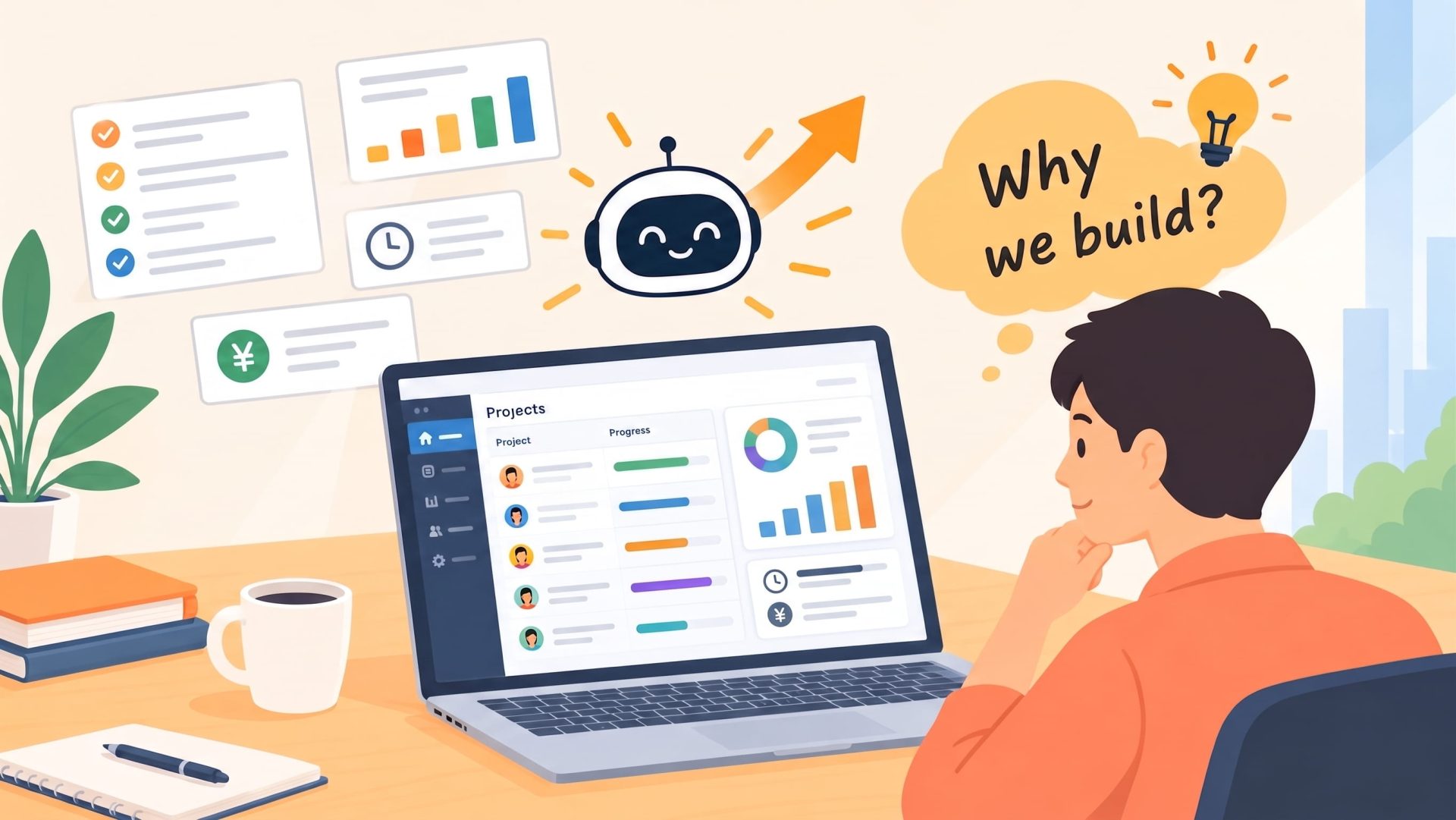
Developing an AI-powered project management tool in-house — The faster we create things, the more important it becomes to understand "why we are creating."
Developing an AI-powered project management tool in-house — The faster we create things, the more important it becomes to understand "why we are creating."
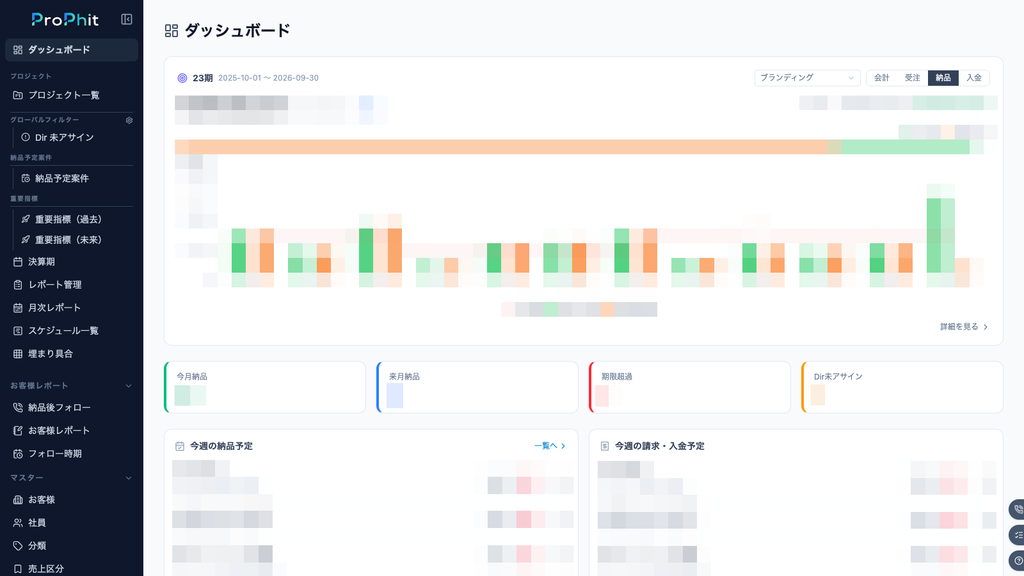
At Lionheart, we developed our own project management and effort tracking tool, "ProPhit," using an AI agent, and we use it internally.
We've started working on AI agent development in other areas as well, and I've been repeatedly surprised by how quickly the code takes shape. However, the more we worked on it, the clearer it became that the overall speed and quality of development are determined by what comes before that.
To explain this, let's look back at how ProPhit came to be.
Existing services fell just short.
Up until now, I've managed projects using various services such as monday.com, Brabio!, and Google Sheets. All of them are excellent services, and they've genuinely helped me over the long term.
Even so, there were still some things that remained out of reach.
For example, when you want to see the progress of a project, the man-hours spent on it, and the revenue generated all at once: how far along is the project, how much time is being spent by each person, and how much revenue is being generated? It was difficult to find a service that could handle all three of these things in one place. As a result, we had to create a separate intermediate program to connect the data.
Furthermore, when you look at the figures for a project depends on your objective. Sometimes you want to see them when the order is confirmed, other times when the product is delivered, or when payment is received. Even for the same project, the months in which the figures appear will differ depending on the criteria you use. Existing services are often designed with the assumption that sales are measured at a single point in time, and they don't provide support for this shift in perspective.
Even if the tool itself is excellent, the more you try to adapt it to your company's rules and the numbers you want to see, the more custom-made additions you end up making around it.
The fact that some things were out of reach became part of the requirements.
We weren't able to write down the requirements from the beginning, saying, "We want this kind of tool."
I was able to start writing because I used many different services. With each use, I became clearer about what was lacking and what I really wanted to do. Conversely, I also came to understand features that seemed convenient but I didn't actually use.
Looking back, I think that the period of trial and error itself was the process of putting into words what the ideal state for our company should be.
As we continued this process, the quality of development using AI agents improved to a level where it could be used in practical applications. So, we decided to give it a try and started developing ProPhit.
During development, we addressed aspects that were previously out of reach from the outset. In addition, we ensured that data aggregation for each person in charge, as well as daily and monthly reports, could be completed within this system, and the entered numbers were reflected in the aggregation immediately. In this way, we created the tools necessary for our company's operations.
The only thing that changed was the manufacturing process.
What I learned from trying it is that AI-driven development is no different from other uses of AI, and no different from delegating tasks to humans. The key is how accurately you can communicate the objective and how well you can review the results.
This might get a little technical, but this is what happened.
In the early stages of development, customer information was included within the project data. This did work, but in our line of work, we often receive multiple projects from the same customer. With this approach, the same company's information would be duplicated across projects, potentially leading to missed updates when changes occurred. Therefore, we changed the system to manage customer information separately and link it to the project.
This isn't a technically sophisticated judgment. It's something that comes to mind if you understand how your own business operates. AI will accurately create something within the scope of the given objective. That's why the precision of the objective you provide and the understanding of the person evaluating the output are crucial.
Furthermore, in terms of speed, it was incomparable to anything we had experienced before. Because we had gone through trial and error with various services, we knew the requirements our company needed, and because we had previous development experience, we could conduct reviews. With AI added on top of that foundation, what we had envisioned quickly took shape.
The order of the LH method remains unchanged even in AI.
LionheartLH methodThere is a method for organizing problems as follows: Visualize the ideal state and the current situation, and define the gap between them as a problem. This approach asks "why are we making it?" before asking "what are we making?"
The development of ProPhit essentially involved using this same model internally. The period we continued to use our existing service provided a clear picture of our current situation, and the unreachable areas that emerged were the challenges. The only thing that changed with AI was how we created solutions to those challenges.
The lower the cost of creating solutions, the more the outcome depends on how the problem was defined. AI has made it possible for anyone to create things, but what to create was still determined by an understanding of the business and expertise in that field.
While we used this approach to address our own company's challenges, this order remains the same when supporting our clients. Now that the methods of creation have become faster, I believe that the time spent on the preceding steps is what truly determines the outcome.
WRITTEN BY
Satoshi Ukai
Executive Officer
Joined Lionheart as a new graduate in 2009. In 2016, gained experience in launching a subsidiary in the Philippines, learning the joys of organizational reform through systematization. Focusing on "on-site operations" and "Kaizen" (continuous improvement), he plays a central role in the group, realizing and enhancing the quality of the company's sharp ideas with optimal technology. He aims to create a strong organization where diverse talents come together and constantly seek new insights.