


BLOG
Blog

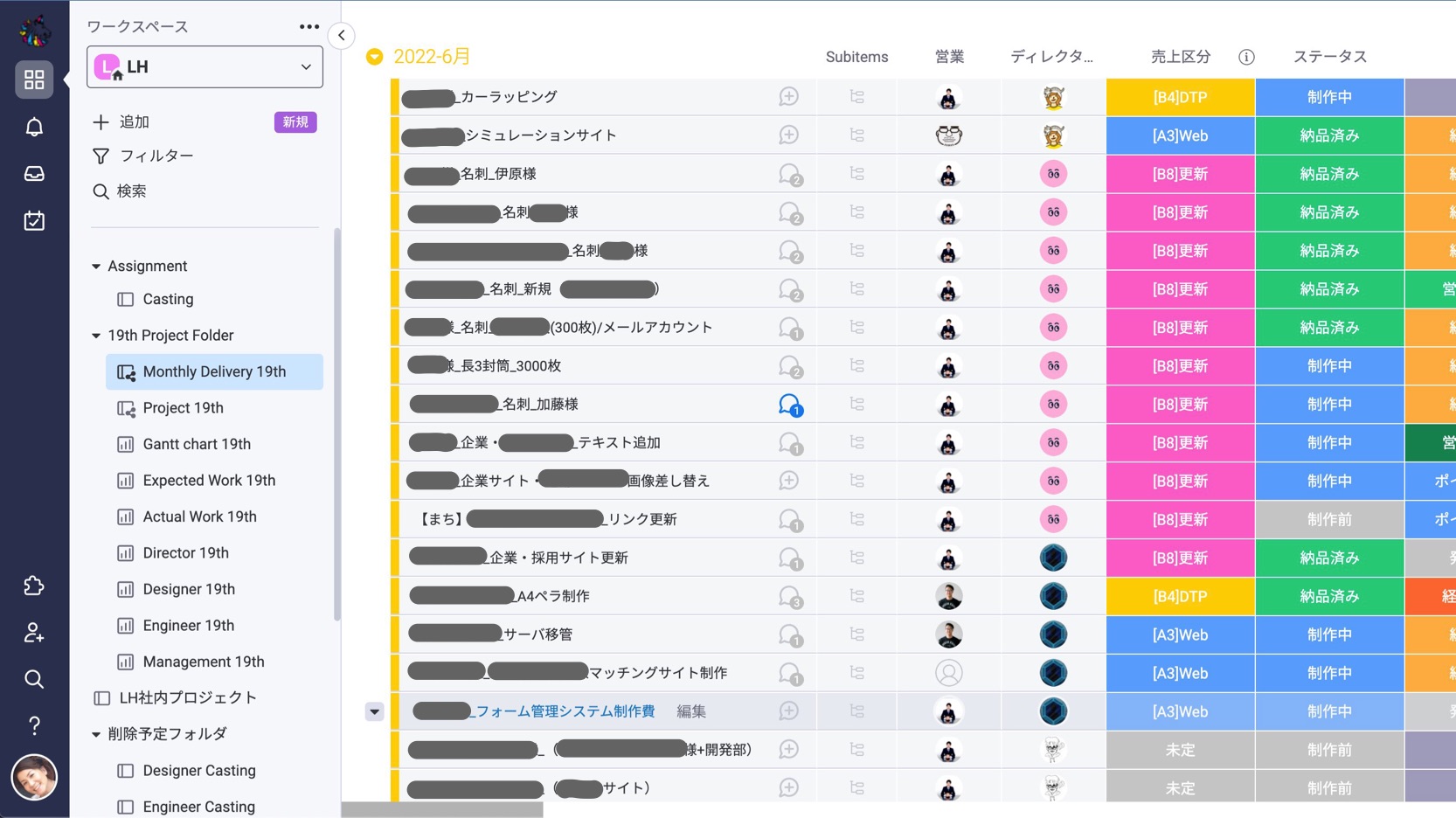
Hello! I'm Takeshi Nakamura, Director and Project Management Leader at Lionheart.
Today, I'd like to share our approach to "project management," a topic that troubles many business owners and managers.
When it comes to project management, even if you introduce a new tool...Problems include difficulty in getting the message across, struggling with how to communicate it to employees, and not knowing what the right approach is in the first place.But I think that's just how it is.
Even I, having been a project management leader for about two years, and still doing so today, have continued to learn through trial and error.
Through careful consideration and development, we have finally been able to eliminate waste, inconsistency, and inefficiency in our operations, and we are now seeing tangible results in areas such as cost management, delay prevention, and employee schedule management.
As a project manager,We made it possible to see multiple projects across different projects.That was a big step forward.
I hope this will be of some help to managers who are struggling, as I will share Lionheart's real-world experiences, touching on various tools, how to use them, their purpose, and their effects.
1. Project from a Manager's Perspective
2. Three reasons why we adopted "monday" as our new tool
3. Seven specific actions taken to ensure the new tool was adopted throughout the company
4. Three benefits of the new tool for project management
5. The potential of internal branding through project management
6. Summary
At Lionheart, we used a management tool called Brabio, which makes it easy to create Gantt charts.
This tool was quite convenient, as it made creating, editing, and sharing Gantt charts much easier than using Excel or Google Sheets.
However, as a manager,It is necessary to have a cross-sectional view of the progress of multiple projects and to understand the resources of the staff.When that came up, I started to feel that Brabio wasn't the optimal tool for my current usage.
For example, with brabio's Gantt chart, it was difficult to accurately grasp how busy each member actually was.
"Mr. A seems busy, but I wonder what projects are piling up and how?"
"Everyone says they're busy this month, but I wonder just how many tasks they actually have to do."
"I think I might be able to entrust you with another case this week."
When I was involved in a project as a director, I only needed to understand the project I was in charge of and the members involved. However, when I'm managing an entire project as a manager, that's not the case.
I needed to oversee multiple projects running simultaneously within the company, and literally needed to grasp the whole picture.
Above all,Visualizing internal resources is a crucial task for me.That's it.
Of course, it's not impossible with Brabio, but from a "project management" perspective, I decided to look again to see if there were any better tools.
[Example of a Gantt chart using the old tool, Brabio]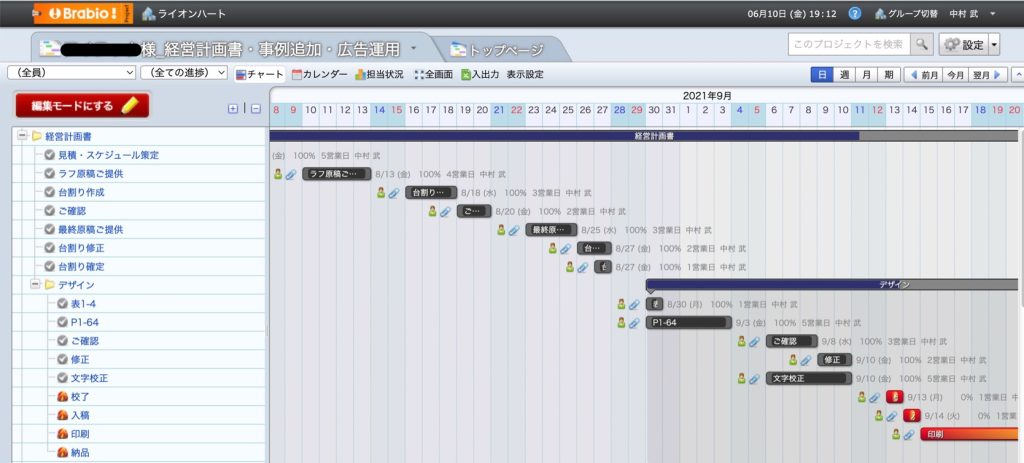
When comparing the tools from various aspects such as price and features, each had its pros and cons, but we ultimately narrowed it down to three: Wrike, asana, and monday, and we chose monday for our company.
By taking advantage of Monday's high level of customization,Visualization of project progress and resourcesI worked on this.
However, the capabilities of the standard settings are limited.
We had to build our own system, including setting up items and establishing operational rules, and it turned out to be quite difficult.
When I casually asked a manager at a partner company about project management, I learned that they were using Monday.
We were in similar industries, and it was reassuring to know someone close by who was actually using it.
As mentioned earlier, it's highly customizable, allowing you to obtain a variety of information, but it requires prior configuration, and this configuration process was incredibly difficult.
Having experienced users readily available for consultation was a great help to me, as I was responsible for implementing the tools.
I believe that most people responsible for implementing tools, like myself, are likely pushing forward with the implementation while simultaneously handling other tasks.
However, the time required to learn the tools and troubleshoot problems is enormous.
If you can get advice from someone knowledgeable, I recommend actively seeking their cooperation, even if it means entering into a paid consulting agreement.I will.
Lionheart's group company, LH&creatives (IT outsourcing), is located in the Philippines, and we often outsource design and coding to them. Coincidentally, the local manager was also independently searching for project management tools and had been attending monday's online seminars and conducting research.
In our case, since some of our workflows are handled by our overseas group companies, a multilingual tool (Japanese and English) was an essential requirement.
Given Lionheart's industry, our employees already have a high level of digital literacy, so I don't think they had much resistance to using the tools themselves. However, we did make some efforts to ensure their adoption within the company, so I'd like to share seven specific examples.
When implementing new initiatives company-wide, such as introducing new tools, it's best to avoid having to explain the same things over and over again.
In our company, we hold a company-wide morning meeting every Monday, so we decided to hold the information session after that meeting.
Informing everyone is an effective way to establish that it is "company policy" and to foster a sense of "everyone working together."That's it.
Furthermore, there is often resistance within the company when introducing new tools.
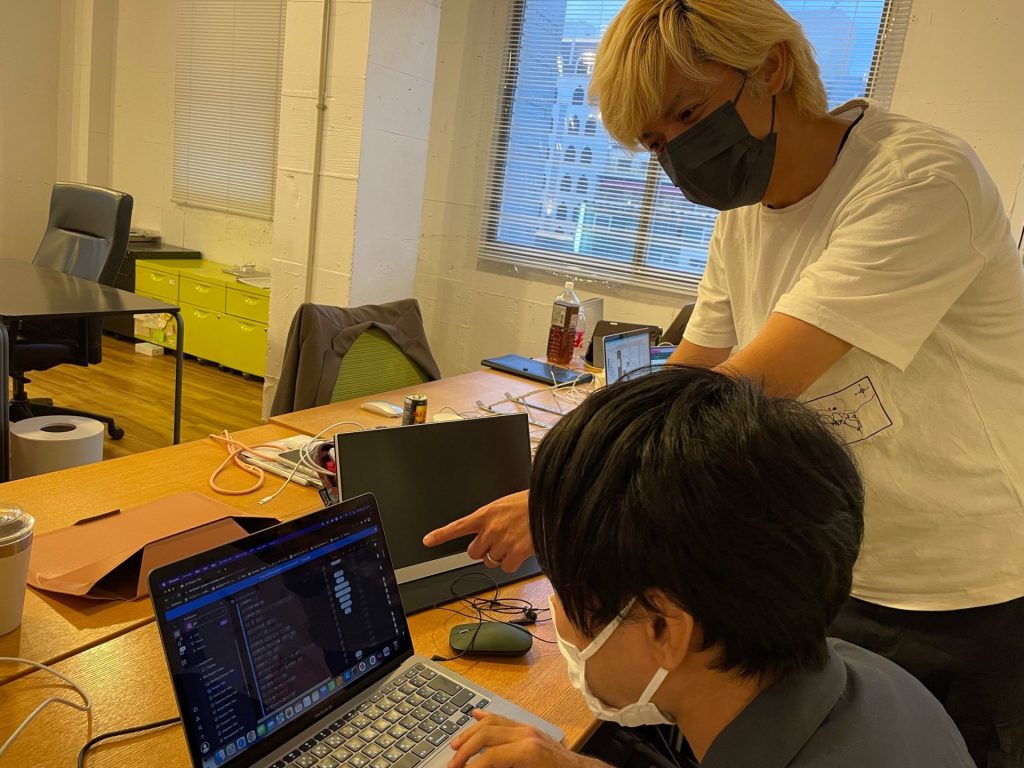
Resistance is likely to arise if you can't concretely envision the situations in which you will use it and the benefits it will bring you.Therefore, I prepared a sample project that seemed realistic and gave a lecture on how to use it.
Lionheart has accumulated a wide range of internal knowledge."Company wiki"We have a system in place, and we've decided to include Monday's operational rules there as well.
As with anything, in project management, rule updates are inevitable once operations begin.
An environment where you can edit and share the latest rules.We recommend that you prepare this.
[Monday explanation page on the company wiki]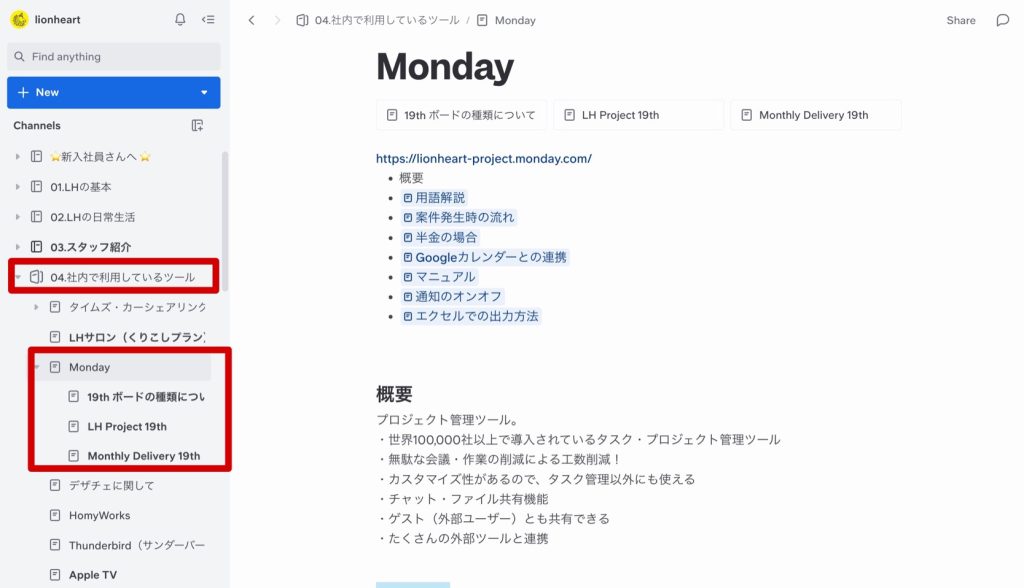
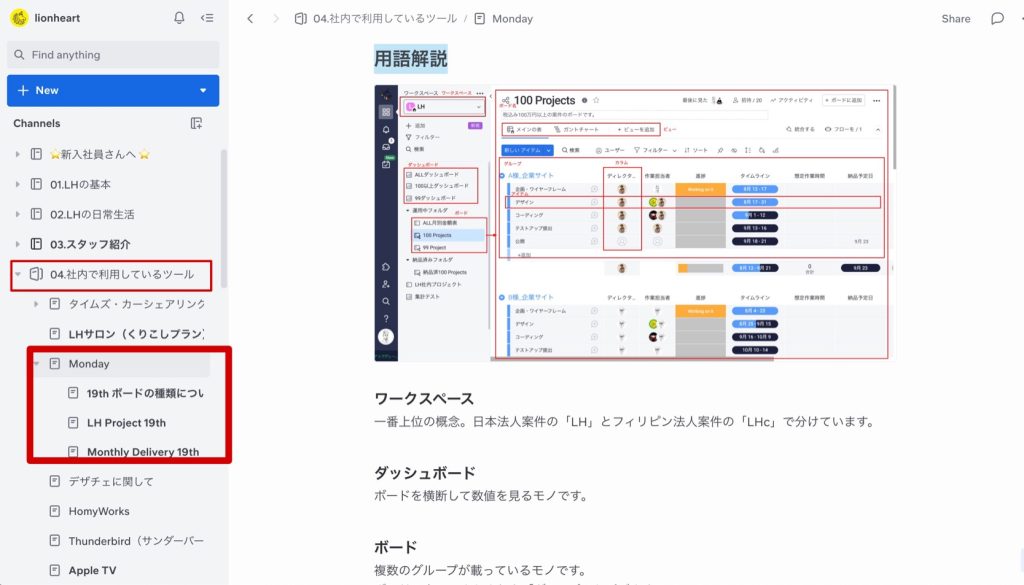 This wiki includes explanations of basic tools and unique terminology such as "this is called a board" and "this is called an item," so that you can understand the basics by reading it.
By accepting questions and inquiries about Monday via chat, we've created a convenient platform for people to ask questions and seek advice.
When introducing tools, theseSetting up a casual contact point is a good way to gather customer feedback, so I recommend it.Is.
It's also convenient for communicating several things at once; newly added rules, for example, can be announced via chat.
Unlike verbal announcements, chat messages leave a record as comments, so you can't say, "I didn't hear anything about that."
As the person in charge of implementation, I am actively using it.
However, information gets lost in chat, and once you miss a conversation, you never look at it again.
The content of the exchange and the answers to the questions will be compiled and posted on the company wiki.Let's go.
[In the chat room for Monday operations]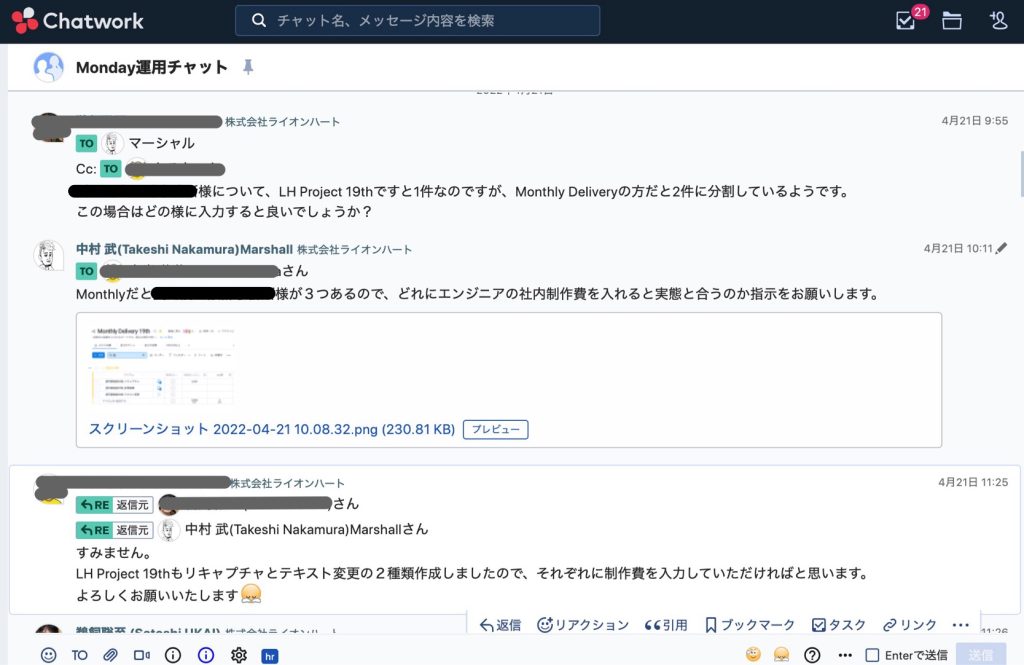
As mentioned earlier, we asked a senior user of Monday to provide consulting during the implementation process, and we met every Friday.
When introducing new management tools or systems, one often overlooked cost is the time it takes for the person in charge to learn them.
I received various questions throughout the week, but I consulted with senior users every week to finalize the operational policy, and then shared it with the team via chat after the meeting.
Having an environment where I could ask experienced people for advice allowed me to resolve my questions smoothly.
Surprisingly, the biggest change might have been that I stopped using Brabio.
Since we introduced Monday the month after our Brabio contract ended, we were in a situation where we absolutely had to migrate.
Depending on the function,I've heard some people say things were better before, but there's no going back, so "we just have to do it."That's how it felt.
It's not that there weren't any comments from the members saying things like, "This is difficult to use," or "The previous version was better," but instead of emphasizing the merits of Monday each time,
"That's certainly true."
"No tool is perfect, and it'll probably be updated over time, right?"
and,We do not expect short-term results from changing tools.I did that.
In addition, in our previous project management system, we used Excel spreadsheets in addition to Brabio, and we used different tools depending on the size of the project. However, when we decided to unify everything with Monday, we set aside a period of about three months to continue using Excel alongside Brabio.
Rather than a sudden, complete transition, we'll gradually introduce the new tools to employees, and I myself will dedicate as much time as possible during the initial implementation phase to ensure the gradual adoption of the new tools.I worked in that capacity.
With monday, you can intuitively grasp the workload for each period visually.
To put pressure onI didn't mean to say, "If you don't input data regularly, you'll look like someone who doesn't do any work at all," butBy using it as a tool that management also reviews, it plays a role in encouraging proactive input.I think so.
In this wayInvolving management is also key to establishing new initiatives.That's right.
While the change in project management tools didn't necessarily make our daily work any easier, from a manager's perspective, the ability to oversee multiple projects across different areas offered many advantages.
For example, the number of projects a single director delivered in a year was something we couldn't know unless we specifically counted them, so we could only grasp it through a feeling like, "Probably person B worked harder than person A."
MondayBy centralizing the data, it becomes possible to quantify not only the "number of deliveries" but also various other metrics such as "average production time," "gross profit margin," and "delay rate" for periods such as months and years.It has come to this.
Things like, "They handle a lot of projects with lower unit prices, so that's why their average unit price is around this much," or "They're generating a lot of profit without relying too much on external contractors," etc.The results of each member's strengths and efforts, as well as the overall monthly achievements, can be seen at a glance.It has come to this.
While the exact figures for accounting weren't known until after the financial statements were finalized, the constant display of "sales" and "gross profit margin" allowed for a reasonably accurate prediction of profits.
Once you can get an overview of the entire project,You can see when human resources will become scarce.It will be like this.
Then,Take proactive steps, such as consulting with partner companies in advance to secure resources.You can.
Conversely, during periods when resources are likely to become available,I'll work with the sales team to get them to start their projects ahead of schedule.You can also do that.
Being able to predict the future with a certain degree of accuracy would be very helpful, as it would allow us to consult on matters such as hiring and capital investment.
[Monday's Director-Specific Circular Schedule]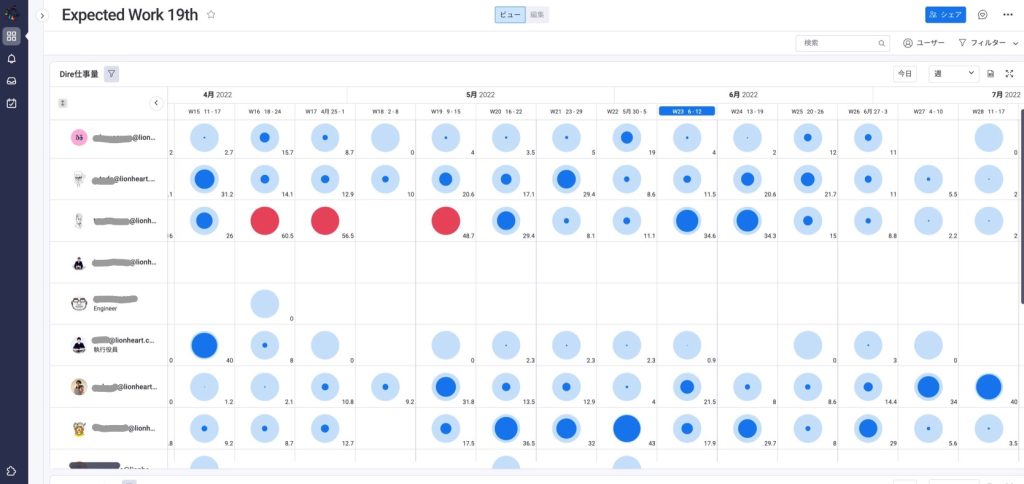 For example, if you set the maximum weekly work time to 40 hours, the circle will turn completely red once you reach 40 hours, indicating that you cannot add any more tasks that week.
Things like "C should be quite free next month" or "We'll have a lot of deliveries piling up in three months and won't have enough engineers" were things we could only know through "years of intuition," but now that this is made visible with monday, it's much easier to see what our employees' schedules are like.
An environment where individuals can demonstrate their abilities while feeling that their work is being properly recognized by their superiors.I hope that's possible.
As the next step in project management,Not only quantitative evaluations that can be converted into monetary value, but also qualitative evaluation criteria.I'm thinking of adding that in the future.
For example, even if two projects are worth the same 1 million yen, the content will differ depending on the client.
If we evaluate based on sales and profits, then perhaps we can simply look at those numbers and evaluate mechanically.
Furthermore, if we evaluate performance based on sales, how should we evaluate two people who both generate 1 million yen: one who handles one 1 million yen transaction and another who handles 100 transactions of 10,000 yen each? It seems that quantitative evaluation alone may not be sufficient in some cases.
Therefore, factors such as price, delivery time, and working hours are important.For aspects that can't be captured by numbers alone, we're thinking of adding our own evaluation criteria, such as "challenging," "creative," and "priceless," and tagging them in a way that's like earning medals.
Other comments included, "They created an interesting output," and "Considering the budget, they did a great job achieving this level of completion."I'll leave my personal thoughts as comments.
Our work could be broadly described as "manufacturing," but we don't have specific model numbers for the products we create, nor do we have pre-made templates.
We sometimes receive requests to "redesign a website for recruitment purposes," and after meeting with the client and researching their company, we end up suggesting that "creating stylish uniforms would be more effective than simply making the website look nice."
Given the same budget, I would like to propose a solution that will yield better results, so the offerings are not necessarily predetermined.
Even though we refer to them simply as "websites," their specifications and appearances vary greatly from company to company.
A director's job is to imagine from scratch what is needed, but that aspect is difficult and something I struggle with every time.
To illustrate that simply having good sales isn't enough, a numerical-only evaluation system is too cold for Lionheart.That's how I felt.
Lionheart's philosophy is "creating smiles," but any tools or uses that don't contribute to creating smiles won't even get approved internally.
To put it dramatically,Project management at Monday was also implemented based on the company's philosophy.It is.
For example, if a company gives an employee who has done work that doesn't directly reflect in sales the tag "Priceless," it means that the company values that employee highly and considers them worthy of recognition.
Furthermore,The message is: "Your priceless actions (work) contributed to creating a smile for someone."It can also be.
Not shown in Gantt chartsI hope that making multifaceted evaluation criteria visible will lead to smiles and increased motivation among employees.I think so.
In addition to tagging and commenting,The ideal scenario is to increase the number of evaluation criteria so that "everyone is evaluated based on what they are good at."Is.
Of course, since I'm also a director, I need to be more diligent so that people don't say things like, "The leader isn't doing any work at all."
I think the input process itself is tedious,In order to prevent these valuable tools from becoming obsolete, it's important to set aside time for regular checks and continue doing so that employees feel, "That person is watching," and "We need to keep using these tools."I feel that's the case.
Currently, we check the schedules of engineers and designers using Google Calendar, but eventually, we want to create a tool that will make us say, "We don't need Google Calendar anymore."Let's nurture MondayThat is the goal.
So, what did you think? In summary,
The frustrating thing about Gantt charts is...
●The actual time required for the work was unknown.
● There were limitations to looking at multiple projects from a cross-functional perspective.
The reason we adopted "monday" as our new tool is...
① High degree of customization freedom
② The user was nearby
③ Supports multiple languages
What strategies can be used to ensure the new tool is adopted throughout the company?
① Holding an in-person information session
② Utilization of the company wiki
③ Dedicated chat room for Monday operations
④ Requesting consultation from experienced users
⑤ Cut off your escape route (old tools)
⑥ Don't aim for perfection from the start.
⑦ Explain the disadvantages of not entering data into the tool.
The impact of new tools on project management
★ You can understand the members' efforts and strengths from all angles.
★Profit can be predicted.
★Ability to make decisions with foresight into the future
If project management goes well...
★Employees can understand their own strengths, and everyone can feel like they can be the best at something, which boosts motivation.
★Through the evaluation,It can also be expected to yield results in internal branding, as it allows you to communicate what the company values.
These are the points I've introduced to you.
I would be delighted if even one of these points could be helpful in improving your company's smooth management and project administration.
Blogs in the same category
Same Category

# Management
Developing an AI-powered project management tool in-house — The faster we create things, the more important it becomes to understand "why we are creating."

# Management
The reason why I've started wanting fewer things and why I can't put my purpose into words are probably the same thing.

# Management
What a business leader should really do when they realize, "I can't compete with him."