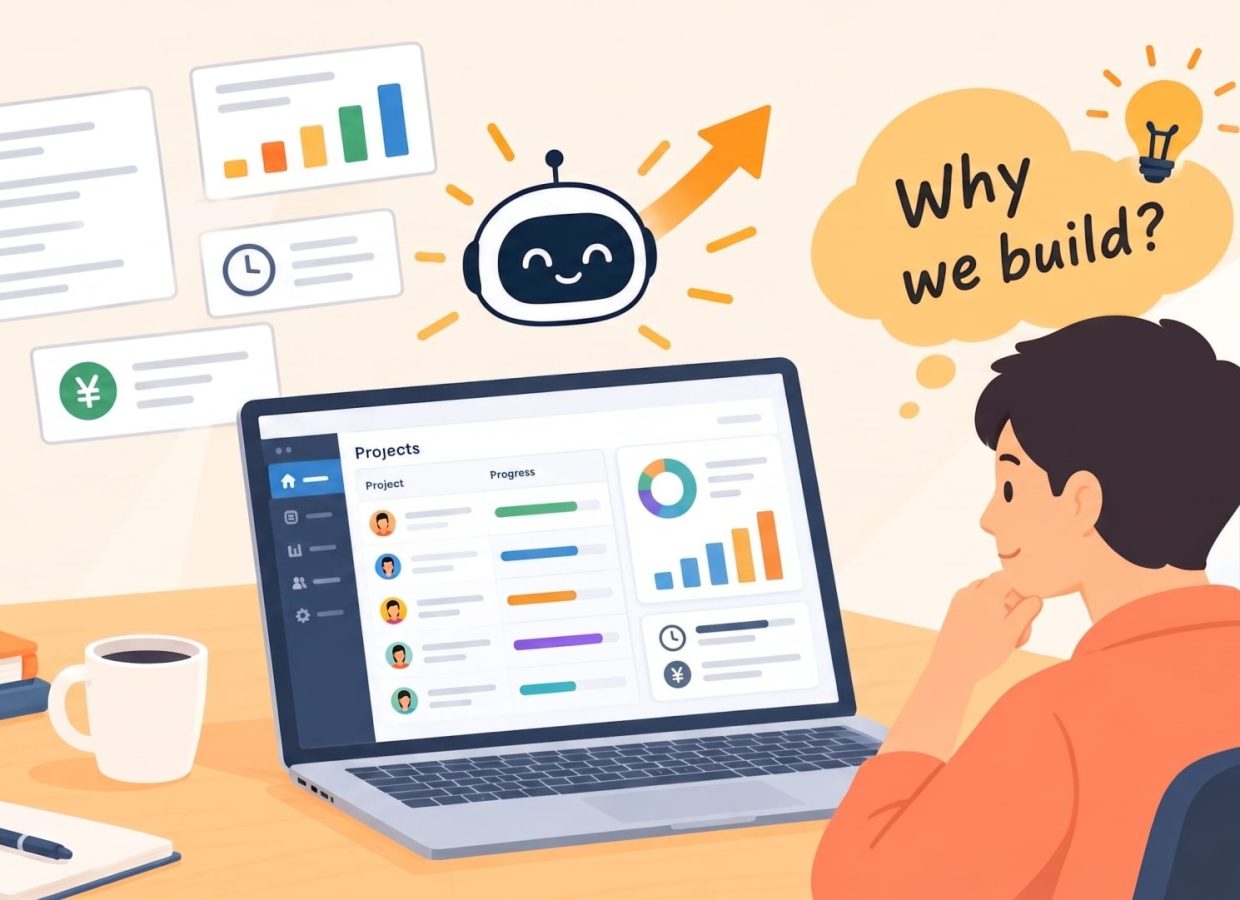
"Meat Proxy" and "No Sheep Needed" — Why I'm Disappointed When Employees Just Execute AI Outputs as Is
Have you heard the term "meet proxy"? It's a new word that's become popular overseas, referring to colleagues who copy and paste answers from ChatGPT or Claude without any critical review. To be honest, when I first heard this term, I was more shocked than amused. That's because I knew someone like that at my company.
Even within the company, there are employees who submit AI-generated work without any review. When that happens, I get incredibly disappointed. For us, who uphold the philosophy of "creating smiles for our customers" and value the LH method, submitting something without review is frankly unbelievable. It's not that AI is bad. It's the lack of review, the complete lack of interest, that's what's sad.
What is a "Meet Proxy"? A new term for people who send AI output directly.
The term "meat proxy" was popularized by German software engineer Niklas Gruhn. In a blog post on August 3, 2026, he wrote about how his friends were directly quoting Claude's responses in Slack and group chats, saying, "This doesn't create any value. I can interact with Claude directly myself. It's faster, and I can control the context myself." A "meat proxy" is someone who simply stands between an AI chatbot and the recipient, copying and pasting without verifying, digesting, or analyzing the content.
This term quickly spread throughout the tech industry. Engineer Corey House posted, "This is the biggest career risk of 2026. I'm actually seeing this problem firsthand," while tech entrepreneur Nicolas Charrière cautioned, "There's a fine line between using AI to increase productivity and becoming a meat proxy." A few months earlier, author Corey Doctorow called the same phenomenon "reverse centaur." Originally, a centaur is a machine body with a human head, meaning a human being helped by a machine. The term has been reversed, referring to a human body with a machine head, meaning a person who has become "a soft, fleshy accessory for an emotionless machine." Though the expression may differ, I think this means that the same sense of unease is beginning to be put into words in workplaces all over the world.
It's happening within our company too. I'm disappointed when employees submit AI-generated answers without reviewing them.
As I mentioned at the beginning, this isn't something we can ignore. Even at a branding agency like ours, we sometimes encounter situations where AI-generated output is simply presented as "okay, it's done." If it's going to be released without review, then there's no need for a human. What's the point of having a human there? I think we need to think about that more seriously.
I don't want to be misunderstood, but I'm not against the use of AI itself. On the contrary, I want it to be used actively. The problem isn't using AI, but the attitude of letting the results go in one ear and out the other without any intention or responsibility on them. For customers, what's far more important than whether the submitted work was "made by AI" or "made by a human" is whether "someone properly considered it." Skipping reviews is also about abandoning interest in the customer. I believe that's the exact opposite of Lionheart's philosophy of "creating smiles."
Perhaps I can say this with such certainty because I myself have always lived my life questioning "what exactly is common sense?" My family runs a pottery business, and I was always a little outside the "normal" family with a salaryman father. That's why I'm particularly sensitive to the kind of thinking that leads to complacency, like "it's right because AI said so" or "it's okay because everyone's using it." It might sound extreme, but I don't want to pay a single penny for work that's just passed on without questioning or critical thinking.
It has the same structure as "sheep." Spontaneity and AI dependence have in common the lack of a "starting point."
There's a saying in our company, "We don't need sheep." It's a phrase that often comes up in conversations with the managing director, with whom I have many opportunities to talk, and before I knew it, it had become a common language within the company. I'm sure some people are taken aback by it, but that's okay. That's the feeling I've always intended to convey with that phrase.
"Sheep" doesn't mean someone who is docile or bad. In short, it refers to someone who won't act unless told, or who won't notice something unless told. Here, we clearly distinguish between "spontaneous" and "proactive." A spontaneous person will ask, "What should I do next?" after finishing a task. They have the motivation to act, but their starting point is always someone else's instructions. A proactive person is different. They start making suggestions even while you're still talking. "What about this case?" "If that's the case, then we could also do this, right?" They're the type who understands ten things from hearing just one.
And this applies directly to how we interact with AI. Simply asking AI, "What should I write next?" and submitting the answer it provides is exactly the same as a "sheep" constantly asking its boss, "What should I do next?" The only difference is that the other party has changed from a human to a machine; the essence of "not creating a starting point in one's own mind" remains unchanged. In fact, because AI will provide answers to any number of instructions, the "sheep" phenomenon can progress more quietly and on a larger scale. I think the reason the term "meat proxy" is so poignant is that it simply gives a new name to this structure that we were already familiar with.
Why is a review necessary? The idea that reporting, contacting, and consulting are the smallest units of "creating smiles."
Have you ever struggled to find a suitable English translation for the Japanese phrase "Horenso" (reporting, contacting, and consulting)? Report, Inform, Consult. They're close in meaning, but somehow not quite right. I think that's because Horenso isn't just a work activity, but a "custom" that embodies Japanese business culture itself.
What happens when communication (reporting, contacting, and consulting) is lacking? Lately, I've noticed an increasing number of instances where communication within the company has become weaker than before, and proportionally, small problems are becoming more noticeable. Things that could have been fixed with a slight adjustment end up being discovered quite far into the production process, sometimes requiring a complete redo. In that case, all the time spent up to that point is wasted. Time that is useless to anyone, produces no productivity, and contributes nothing to anyone. That can't be called work.
We view reporting, contacting, and consulting as "the simplest way to create smiles, something even new employees can start doing today." We value it not as a means of efficiency, but as an act of fostering trust with customers, partners, and colleagues. By reporting, contacting, and consulting, the other person's anxiety is reduced, and a sense of security and trust is created. This accumulates and eventually turns into trust.
I believe that the act of reviewing is actually the first step in reporting, contacting, and consulting. Instead of blindly accepting the initial response from AI, you need to verify it yourself, add context and responsibility, and only then is it ready to be handed over to someone. Only after doing that can you finally stand at the starting line for reporting and consulting. Skipping the review process means that you are simply forwarding the information received from AI without any verification whatsoever. Not only is reporting, contacting, and consulting impossible, but the information never even passes through a human's hands.
And this isn't just a problem for those sending information from within the company. To be honest, it's not uncommon for manuscripts and materials received from clients to actually be "meet proxies." The numbers might not be consistent, or there might be parts that don't fit the context. Information that arrives without being reviewed ultimately requires us, the recipients, to re-check and verify the facts. If someone skips the step of review, that burden is inevitably passed on to the next person who receives the information. I think this is an unchanging principle when information is passed from person to person, not just limited to AI output.
AI won't take away jobs; it's "losing interest" that will take away people's jobs.
According to a survey on corporate trends regarding generative AI conducted by Teikoku Databank in March 2026, 34.51 TP3T companies are using generative AI in their operations. Of these companies, 86.71 TP3T responded that they were seeing positive effects on their operations, but there is a clear difference depending on company size. Companies with more than 1,000 employees have a utilization rate of 63.61 TP3T, while companies with 5 or fewer employees have a utilization rate of only 29.61 TP3T. This is often referred to as the "AI gap," but looking at these figures, I think the gap is not just due to differences in implementation costs or the amount of information available.
The real disparity lies in the difference in literacy regarding "how to handle AI's answers." Even when using the same AI, the quality of output a few years down the line will be completely different between organizations that blindly accept the output and those that use the output as material to refine it into their own words. We often hear talk about AI taking away jobs, but I have a slightly different perspective. It's not AI itself that will take away jobs, but the attitude of humans who stop caring about the AI's answers and asking themselves, "Is this really okay?" The moment you lose interest, you become a "meet proxy," a replaceable entity. Ironically, the more people fear AI and stop thinking for themselves, the more likely they are to be replaced by AI.
Proactiveness isn't a talent. It's about staying "forward-looking" alongside AI.
When people hear the word "proactiveness," some might think it requires special talent. But I don't think so. Everyone has moments in their daily lives where they are naturally proactive. Engaging seriously makes things enjoyable. Enjoyment makes you want to engage more deeply. I believe that this repetition is what creates people who can act proactively. Those who say, "I don't know what to do next," may simply not have reached that starting point yet.
Depending on how it's used, AI can be either the best sounding board or a convenient excuse for intellectual laziness. The dividing line is simple: whether you can stop before the answer the AI provides and ask yourself, "Will this really make our customers happy?" Only individuals and organizations willing to take that extra step can make AI their weapon, not just a substitute. What we value isn't special skills to avoid having our jobs taken by AI. It's the initiative to think ahead and go one step beyond the AI's answer.
"We won't become a meat proxy," "We won't become a sheep." It's easy to say, but when an organization seriously tries to uphold that principle, it's surprisingly difficult. That's why I believe whether a company is truly committed to that principle is a subtle but reliable criterion when choosing a branding and marketing partner. If you feel that the "human touch" has disappeared from your current partner's proposals, I'd like you to come and talk to us.
After starting his own business at the age of 26, he has over 20 years of management experience in the design and branding fields. In 2016, he moved with his family to the Philippines and established a local IT outsourcing company, leading its global expansion. Currently, as a "GLOBAL BRANDING AGENCY," he supports the growth of companies while also actively working on organizational reforms within his own company. Based on the real-world struggles and firsthand information he has faced in organizational development and overseas management, he shares practical branding and organizational theories that are thoroughly aligned with the perspective of business leaders.