


BLOG
Blog

Companies have all sorts of information; how do you manage it?
If it's a data file, you could establish naming conventions and save it to the cloud...that's one possible approach.
However, have you ever considered that "a company possesses more information than just data files"?
For example, have you ever had the experience of forgetting your company's Wi-Fi password and having to ask for it multiple times?
Including this kind of information, companies of all sizes possess a vast amount of data.
Many companies have a written document outlining what they value, such as their "philosophy."
So, have you thoroughly explained its origins and how it came to be?
Simply displaying it on the wall of the president's office won't get the message across.
While a company's values, exemplified by its philosophy, are undoubtedly important information, they are surprisingly often not shared in concrete terms.
Since values are something that should be shared consistently without wavering, it's important to put them into writing.
We recommend including the company's core values (such as philosophy and vision) in the company wiki.
You can easily find it with a quick search, so don't worry if you forget.
I think many companies use chat for internal communication.
It's convenient when a staff member asks a question and you get a helpful answer right away.
However, the problem is that those helpful answers become useless at that moment and get buried in the wave of chat.
This answer might be useful again someday, but only those who were watching the conversation would know that the crucial answer is in the chat.
And you'll end up asking the same questions over and over again in the chat.
Information (answers) that might get lost in such chats can also be easily found by registering them on the company wiki and searching the wiki.
The same explanation is repeated every time a new staff member joins the team.
It's helpful to compile such information on the company wiki and have employees read it before joining the company or on their first day.
For example, when a new employee wonders, "How should I handle the reimbursement of travel expenses when I go on a business trip?", they might not know who to ask. Of course, they might also feel hesitant to ask.
That's where the company wiki comes in. If you search it, you can find information about expense reimbursement for travel expenses, and it's immediately clear who to contact.
Furthermore, in terms of education, the company wiki can serve as a teaching tool for middle managers, allowing for training through the wiki.
As a result, it leads to the realization of consistent and unwavering education and management.
Consistency in education can have a significant positive impact on internal branding.
The effectiveness can be further enhanced by creatively designing the content, but this will also vary depending on the company's vision and corporate culture.
we,
- The story from the company's founding to the present (a kind of autobiographical account from the CEO)
• Things we value, such as our philosophy, vision, and guidelines.
This is explained in a very large number of words.
We also post and update information related to our work as it becomes available.
The result was an enormous amount of text, but this itself has become a form of branding for us, and it has attracted the interest and attention of our customers.
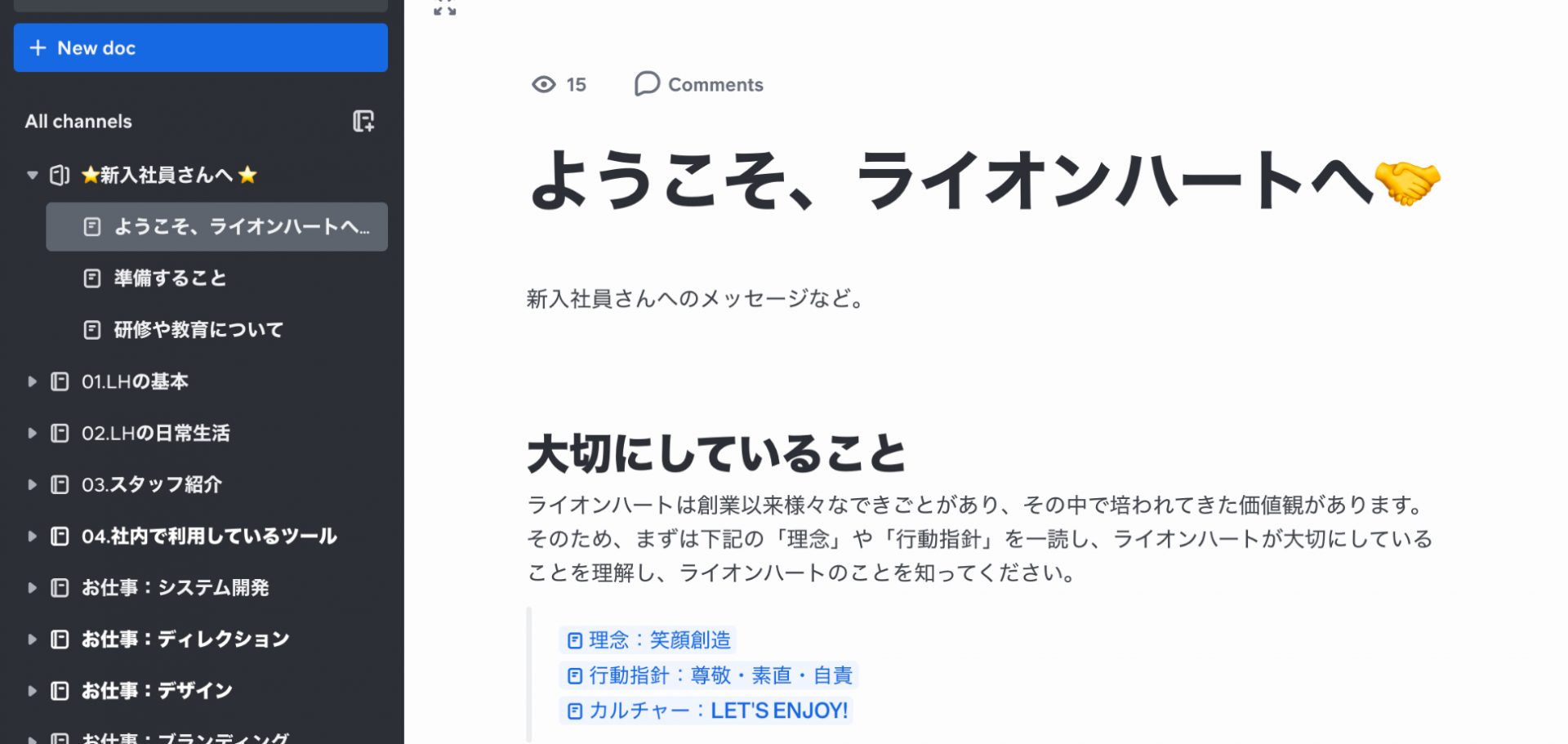
We use a wiki tool called slite.
It has the minimum necessary functions for an internal company wiki and is easy to use, so I recommend it.
There were many other similar tools, but I chose this one because of its user-friendly UI and overall appearance.
Online documents, such as those from Google Workspace, include URLs to direct users to the necessary information.
We use it as a table of contents and search tool for information within the company.
There's also a smartphone app available, so it's convenient to carry around like a notebook.
Google Workspace, which is used by many companies, has a powerful search function, so I think it can be used as an internal wiki if you establish clear rules and operate it properly.
In our case, we had been using Google Workspace for several years, back when it was G Suite.
As a result, the Google workspace itself had become a chaotic mess with insufficient organization of information.
Considering these factors, as well as ease of updating and how it would perform on a smartphone, I concluded that a tool specifically designed for wikis would be more suitable.
Before implementation, we narrowed it down to about five tools and conducted a test run.
Compared to back then, it seems like there are more internal wiki tools available now. (I have the impression that there are especially more domestically produced tools.)
While there were some highly functional options available that I found appealing, considering our purpose for implementation, basic internal wiki functionality was sufficient to start with.
We thought that if it became any more complicated, the staff, who are the users, would feel stressed.
This is actually the most important point: from the staff's perspective, it can feel like they're being forced to learn something new, so we chose a tool that is easy to understand, simple, and intuitive to use, both in terms of functionality and appearance.
We recommend that you carefully consider the purpose of starting an internal wiki for your organization, what features are necessary to achieve that purpose, and then use the tool that you believe is most suitable.
The company has accumulated a history, and there should be just as much information associated with it, but that information is not something that can be visually perceived.
For example, with paper documents like financial statements, you can visually perceive the history over a 10-year period.
As mentioned earlier, for important but vague information that isn't readily apparent, I recommend accumulating it in an internal wiki, similar to scrapbooking, as it changes over time.
Furthermore, these kinds of initiatives contribute to a company's branding, so I recommend them.
Blogs in the same category
Same Category

# Management
Developing an AI-powered project management tool in-house — The faster we create things, the more important it becomes to understand "why we are creating."

# Management
The reason why I've started wanting fewer things and why I can't put my purpose into words are probably the same thing.

# Management
What a business leader should really do when they realize, "I can't compete with him."