


Every Monday, our staff takes turns planning and running the company-wide morning meeting.
This time, I'd like to share what we've learned at our company regarding common pitfalls in morning meetings.
Our company-wide morning meeting, perhaps because it's at the beginning of the week, often focuses on topics related to our daily work. However, if this continues, when it's my turn to give the talk, I tend to think, "Maybe it's better to talk about work-related topics after all..."
Some companies hold morning meetings, but don't you sometimes find that these meetings are becoming increasingly rigid and restrictive?
While it's not necessarily a bad thing to create a sense of tension and seriousness, if it goes too far, it can lead to people disliking the morning meeting because it's preachy.
Of course, there are probably some business owners who think, "That's what morning meetings are supposed to be! We should be raising our voices from early in the morning..."
Of course, there's absolutely no problem if the objective is clear and it leads to results.
By the way, how are the objectives set for our company's morning meetings?
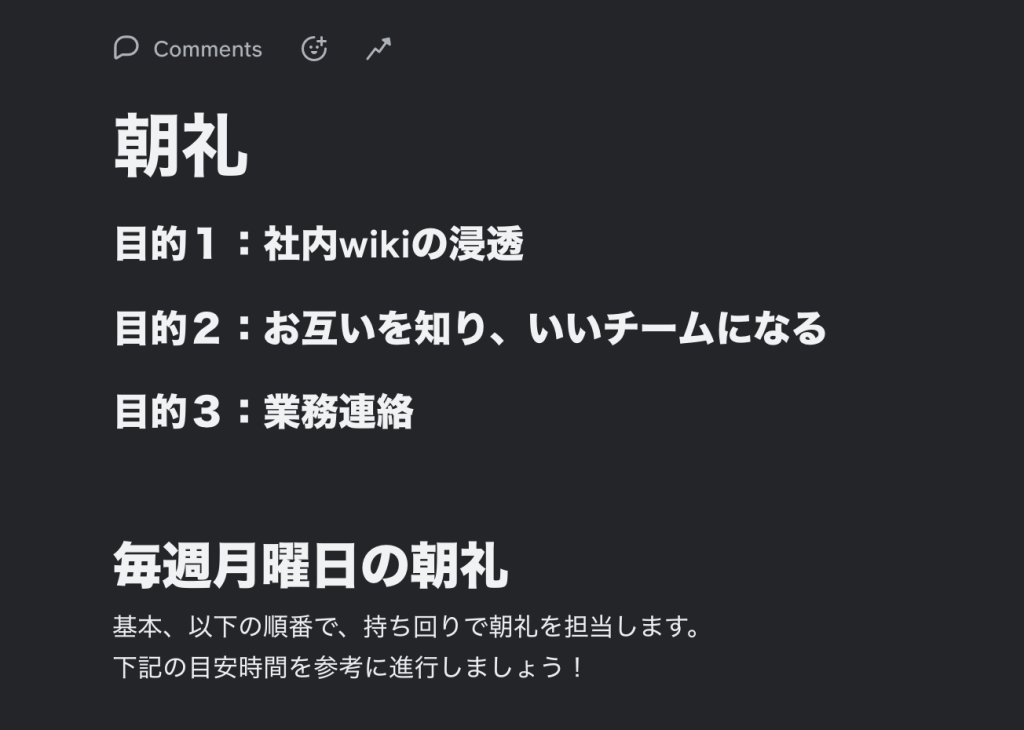
According to the company wiki...
...or so they say.
Objective 1: To promote the use of the company wiki.
Objective 2: Get to know each other and become a good team
Objective 3: Business communication
Our company plans and conducts morning meetings in accordance with these objectives.
An internal company wiki is a wiki that compiles various rules within the company (including how to dispose of garbage), and by searching there, you can find out a variety of things, from the company's philosophy and history to how to apply for paid leave.
Please refer to the article below for information on our company's morning meetings and internal wiki.
There are many factors involved, but I think it largely depends on the psychological state of the recipient (participant).
For example, when you're extremely busy and pressed for time to meet deadlines, under immense pressure to achieve targets, or mentally exhausted from dealing with customer complaints, you're not in the mood for a morning meeting.
Because work is always on my mind.
In that situation, if the topic of discussion on a Monday morning is work-related, wouldn't you think, "Enough already, I don't want to hear it..."?
As I briefly mentioned at the beginning, when you talk about work-related topics on a regular basis, the conscientious nature of Japanese people makes it easy to think that "it must be about work-related topics."
Therefore, even if you leave it alone, the content will naturally become serious, and it will gradually become more formal.
*Of course, this depends on the company culture.
As a result, the morning meetings become increasingly hostile and purely obligatory...
As mentioned above, the purpose of our morning meeting is:Get to know each other and become a good teamThere is something called "...".
In fact, we use it to interview staff from other departments and senior colleagues, to provide opportunities for new staff members to present their achievements, and to get to know each other.
However, this also comes with work, or rather, tasks.
Of course, thanks to projects like this, it's true that I've gained a better understanding of colleagues I don't often work with directly.
So, what about her personality outside of work?
Of course, close colleagues might talk about personal matters, but at work, conversations tend to focus on work-related topics. This is especially true when things get busy.
In your company, too, you might be surprised to find that you don't really know each other, right?
"Wow! You have a hobby like that?!" they exclaim in surprise.
So, I thought, "Wouldn't it be great if we could introduce a different side of everyone outside of work?" and decided to come up with a plan for our company-wide morning meeting.
This way, it's unrelated to work, and the formality level is significantly reduced.
So,
Please tell me about your hobbies and current obsessions.
I asked the question.
Before the morning meeting, we asked everyone to send in a short comment about their hobbies or current interests, along with a related photo. We then compiled these into a simple design, as shown below, and shared it with everyone.
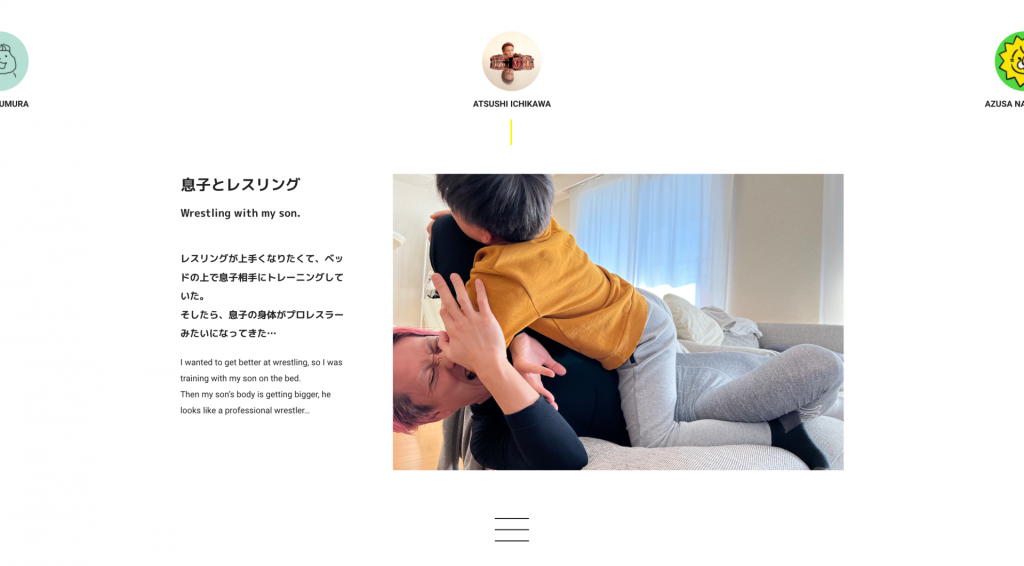
This is about my hobbies and current interests, so it's completely unrelated to work.
I'm sure those listening to the morning meeting felt more relaxed.
(Although they were busy, they did cooperate by sending photos in advance.)
As a result, we were able to catch a glimpse of sides of our colleagues we hadn't known before, and we received positive feedback such as, "It was fun."
Furthermore, conversations naturally arose after the morning meeting that touched upon the topic, creating a different kind of communication than usual.
It's a simple initiative, but it's recommended because it helps to ease the formality of morning meetings and allows you to get to know your colleagues better.
Our company has a subsidiary in the Philippines (IT outsourcing), and we shared the content used in this morning meeting with our Filipino staff.
For the Filipino members, many of the Japanese members are not acquainted with each other.
Given that situation, we're working together, which means we're communicating with each other without really knowing much about one another.
It may seem obvious, but when communicating in unfamiliar English, misunderstandings can easily occur, leading to stress for both parties.
Wouldn't that stress increase even more if you didn't know each other?
By sharing this information, we aimed to help our Japanese members get to know us better, increase engagement with our Filipino members, and foster a sense of closeness.
I think there are few people who are not interested in foreign cultures and customs.
This is also true for Filipinos; they find Japanese trends and hobbies interesting.
Wouldn't morning meetings be more sustainable if they were slightly adjusted according to the situation?
We also operate our morning meetings using our own ingenuity and creativity, so we don't know if this is the correct way, but we wanted to share it in the hope that it might give you some hints for running your morning meetings.
Blogs in the same category
Same Category
# Management
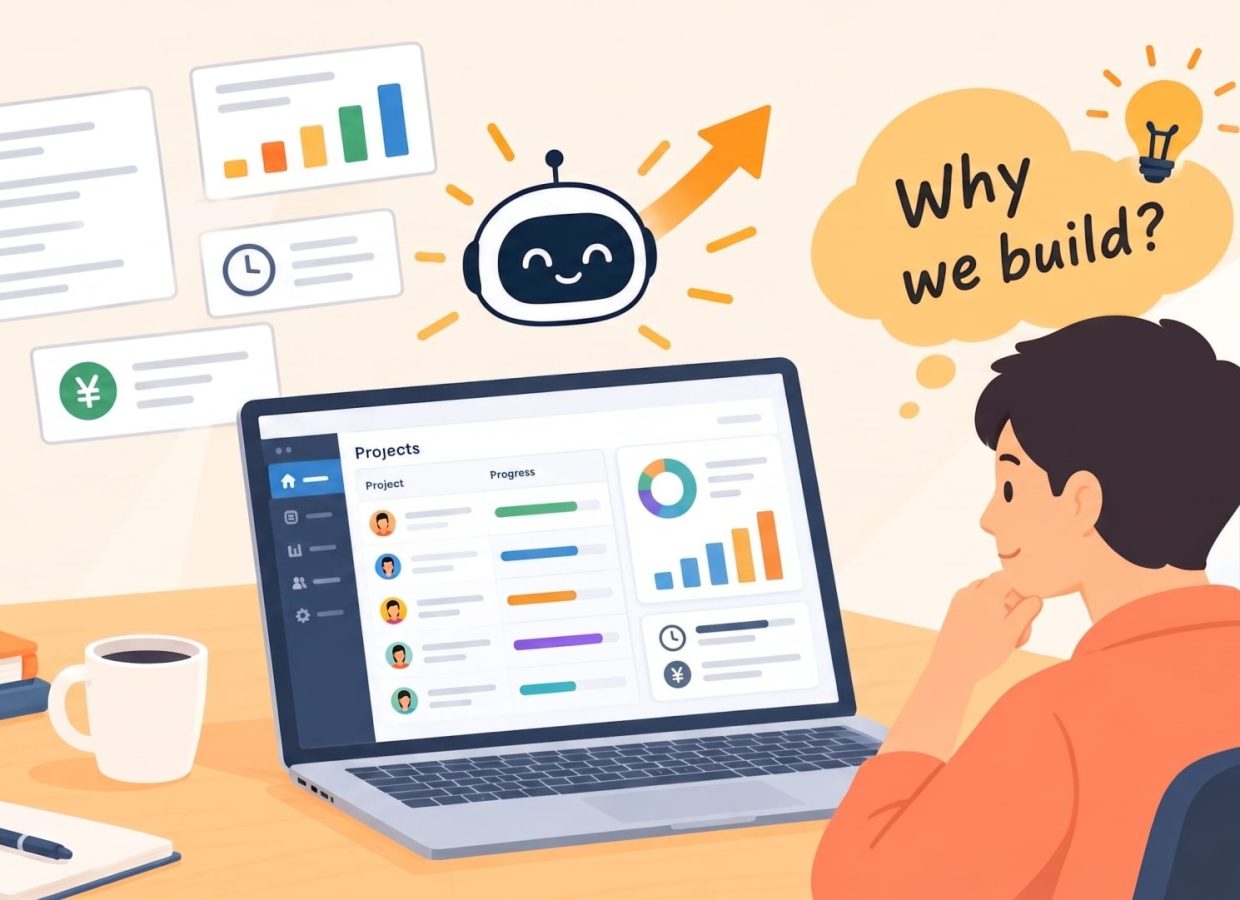
Developing an AI-powered project management tool in-house — The faster we create things, the more important it becomes to understand "why we are creating."
# Management
The reason why I've started wanting fewer things and why I can't put my purpose into words are probably the same thing.

# Management
What a business leader should really do when they realize, "I can't compete with him."
